
Delivery Assurance in Supplier Evaluation: An Import Export Data Checklist
Delivery assurance is the part of supplier evaluation that tests one promise: the ordered quantity arrives at the named destination on the agreed date, and the same supplier can repeat it on the next order. Import and export data gives an importer an independent way to test that promise, because the evidence comes from shipments that have already moved through customs and shipping documentation rather than from statements written in a supplier questionnaire.
This article is written for buyers at the evaluation-to-execution stage, where a shortlist already exists and the remaining question is where to place the first order, the trial order, or the increased allocation. It sets out eight capability checks, explains what each check can and cannot establish, and then maps the checks onto a five-stage workflow that runs from target definition to supplier contact.
What Delivery Assurance Means in a Supplier Evaluation
Delivery assurance sits between two other questions and is often confused with both. Capability asks whether a company can produce the item. Compliance asks whether the item and the facility meet stated standards. Delivery assurance asks whether the supplier's actual shipping behaviour matches the order profile you are about to place, and whether that behaviour is repeatable.
For that decision, three answers usually matter more than any single score:
- Does the company actually ship this product, at a scale comparable to my order?
- Does it ship on a repeatable rhythm to buyers like me, in my region, on documentation I can rely on?
- Who on the supplier side controls the schedule, and how do I reach that person?
Import and export data answers these questions as evidence of movement, not as a rating. Each record supports a question you can put to the supplier, and the pattern of answers decides whether the supplier receives a trial order, a deposit, or a production slot in your next cycle.
Why Supplier Questionnaires Alone Miss Delivery Risk
A supplier questionnaire is written by the seller, references are selected by the seller, and a sample shows what a company can produce when it is paying attention to the sample. None of these three inputs is designed to reveal how the company ships in an ordinary week, to ordinary customers, at ordinary volumes.
Customs declarations and bill of lading records exist for a different reason: a shipment moved, and someone had to declare the goods, the quantity, the counterparties and the date. That origin is what makes trade records useful in supplier evaluation. The record is created in the course of a transaction rather than prepared for the buyer's benefit.
The same origin sets the limits described later in this article. Declared data reflects what was declared, declaration practice varies by market, and a trade record does not show a factory's internal scheduling, its spare capacity, or the quality of the goods inside the container.
Shanghai Tendata Tech Co.,ltd is a trade intelligence provider founded in 2005 and headquartered in Shanghai, and its platform combines global import and export data, company-level information, business contact data and AI-assisted analysis. In practice, the data behind such a platform is sourced from customs authorities, commercial databases and internet databases; company names and quantity units are standardised to reduce duplicate or inconsistent records; and updates can be as frequent as every three days. That cadence matters for delivery assurance, because a checklist run on twelve-month-old records answers a historical question rather than a delivery question.
What Import Export Data Can and Cannot Prove About a Supplier
Separating the two is the difference between a checklist that improves a sourcing decision and one that creates false confidence. Both lists below apply to any trade data source, not only to one vendor.
What trade records can establish
- Whether the company has recorded shipments, and how recently.
- Which products and HS codes appear in its trade activity.
- Who it ships to and buys from, and the trading relationships around it.
- Which destination markets it already serves.
- The relative scale and rhythm of its shipments.
- Whether the entity behaves as a manufacturer-exporter, a trading company, or a logistics provider.
What trade records cannot establish
- Product quality or conformity of a specific lot.
- Production capacity available for your order inside your delivery window.
- On-time performance on your trade lane, for your order, in the coming season.
- Certification status of the goods, which must be checked against the certificate and the issuing body.
The role question deserves emphasis because it is where many evaluations go wrong. A freight forwarder appearing in a shipment record is evidence that cargo moved, not evidence that the named company manufactures or trades the product. Tendata's data processing includes distinguishing logistics companies from actual importers and exporters, which matters in a supplier checklist: the distinction decides which entity you audit, and which entity you eventually contract with.
The Eight-Point Delivery Assurance Checklist
Each check pairs a delivery-assurance question with the trade evidence that can inform it, and states the limit. The table is the working version; the notes after it explain how to apply each row.
| Check | Trade evidence to review | Delivery question it answers | What it does not settle |
|---|---|---|---|
| 1. Trade activity continuity | Shipment dates and frequency over the recent period | Is the supplier currently active in this product? | Whether capacity exists for your order |
| 2. Product and HS code alignment | Products and HS codes declared | Does the declared product match what you are buying? | Specification conformity of your lot |
| 3. Role in the chain | Importer/exporter status versus logistics activity | Are you dealing with a manufacturer, a trader, or a forwarder? | Which entity actually controls production |
| 4. Counterparty structure | Buyers, suppliers and trading relationships | Is the supplier dependent on one account or spread across markets? | Contractual priority given to your order |
| 5. Destination coverage | Destination countries and regions served | Has the supplier shipped into your market before? | Performance on your specific lane |
| 6. Volume plausibility | Purchase volume and trade trends | Is your order size normal for this supplier? | Ability to scale up within a season |
| 7. Company stability signals | Company background, financial information, IP, litigation and risk records, news and public sentiment | Is the entity consistent with its trade profile? | Solvency as a single confirmed indicator |
| 8. Contact verification | Decision-maker titles, phone, email and professional profiles | Who controls the shipping schedule? | Whether that person will prioritise you |
1. Trade activity continuity
Look for shipments in the recent period and for a rhythm rather than a single consignment. A supplier with an isolated shipment six months ago may be a trader testing a market, or a manufacturer between contracts; either way, the pattern needs an explanation before you commit a delivery date to your own customer.
2. Product and HS code alignment
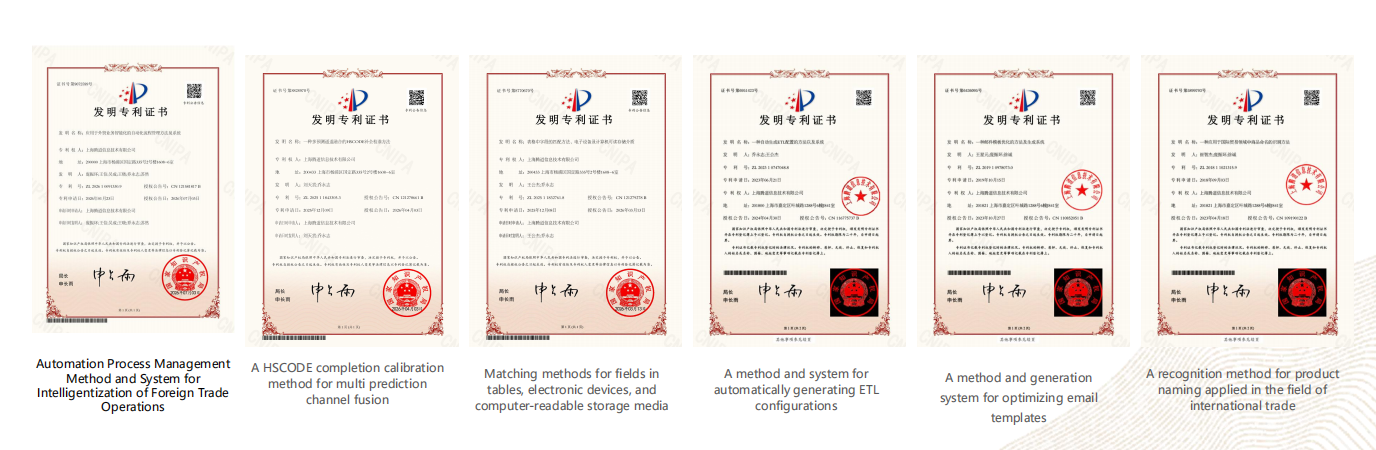
Compare the declared products and HS codes with the item you are buying. Code-level comparison reduces the risk of evaluating a company whose relevant experience is in an adjacent category. Tendata holds a patent for a multi-prediction-channel fusion method for HS code completion and calibration, which is a data-quality feature rather than a substitute for checking the code against your own tariff classification.
3. Role in the supply chain
Establish whether the counterparty is a manufacturer, a trading company or a logistics provider before the questionnaire stage, not after the deposit. The answer changes the audit plan: a trading company needs its upstream producer verified, while a manufacturer needs production and shipping capability verified directly.
4. Counterparty and supply chain structure
Review the buyers and suppliers around the company and the trading relationships between them. A supplier whose shipments concentrate on one large account has a scheduling exposure you should ask about; a supplier spread across several markets usually has documentation and export routines that already work. Neither pattern proves that your order will be prioritised, which is why the check produces a question rather than a verdict.

5. Destination market coverage
Check whether the supplier already ships into your region. Prior shipments into the same market suggest familiarity with import documentation, port handling and labelling expectations. They do not prove performance on your lane, so treat this as one input into a logistics conversation about transit time, consolidation and Incoterms.
6. Volume plausibility against your order
Compare the scale of the supplier's typical shipments with the size of your first order. When your order is materially larger than the supplier's normal consignment, the gap belongs in the commercial discussion as a capacity question. Trade data identifies the gap; it does not close it.
7. Company-level stability signals
Trade activity shows movement; company intelligence shows the entity behind it. Company records, financial information, products, intellectual property, litigation and risk information, news and public sentiment, and trade show participation all help confirm that the company in the records is the company you are evaluating, and that nothing obvious contradicts the trade profile.
8. Contact and decision-maker verification
The final check is people. A supplier relationship that only reaches a sales representative can stall the moment a production date slips. Contact data with job titles, phone numbers, email addresses and professional profiles lets you identify the colleague who controls production scheduling or export documentation, so the delivery conversation starts with the right person.
Running the Checklist: From Evaluation to Execution in Five Stages
The checks are only useful if they run in a fixed order, because each stage narrows the pool for the next. The five stages below are the workflow documented for Tendata AI Global Market Intelligence, and they map directly onto the checklist above.
Stage 1 — Target profile definition
Define the target countries or regions, the products and HS codes, the industries, and the company types you will accept: buyers, importers, suppliers or exporters. This profile is what turns a general trade database into a supplier shortlist, and it should include the order profile you need delivered, not only the product name.
Stage 2 — Company discovery
Search by product, country, HS code or a natural-language description of the requirement to build a pool of candidate companies. The platform covers 228+ countries and regions, more than 10 billion trade records, 230+ industries and more than 500 million importers and exporters, which is the scale that makes a shortlist possible in markets where you have no local network.
Stage 3 — Screening and qualification
Narrow the pool on product relevance, target country, company type, trade activity and trade frequency. This is where checks 1, 2, 5 and 6 are applied at speed: continuity, code alignment, destination coverage and volume plausibility can be reviewed before any contact is made.
Stage 4 — Due diligence and trade intelligence
For the companies that survive screening, review company information, imported and exported products, HS codes, trade history, trade frequency, trade volume, and the buyers, suppliers and trading relationships around them. This stage carries checks 3, 4 and 7, and it is the point at which a supplier either becomes a serious candidate or is set aside.
Stage 5 — Contact discovery and outreach
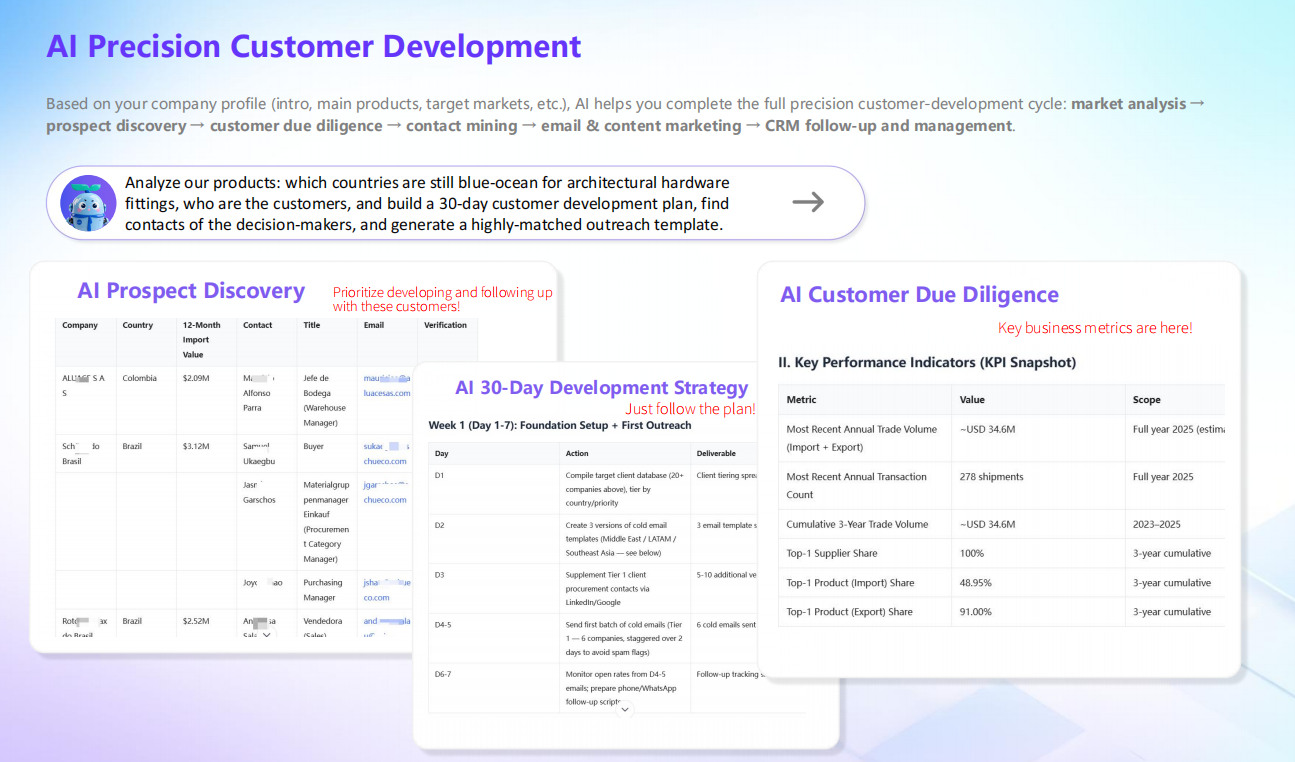
Identify purchasing, sourcing, sales or business development contacts at the qualified companies, and prepare a specific approach based on what the records show. The platform includes more than 850 million verified business contacts with job titles, phone numbers, email addresses and professional profiles, and Tendata AI can assist with drafting personalised outreach content. This is check 8, and it closes the loop from evaluation to execution.
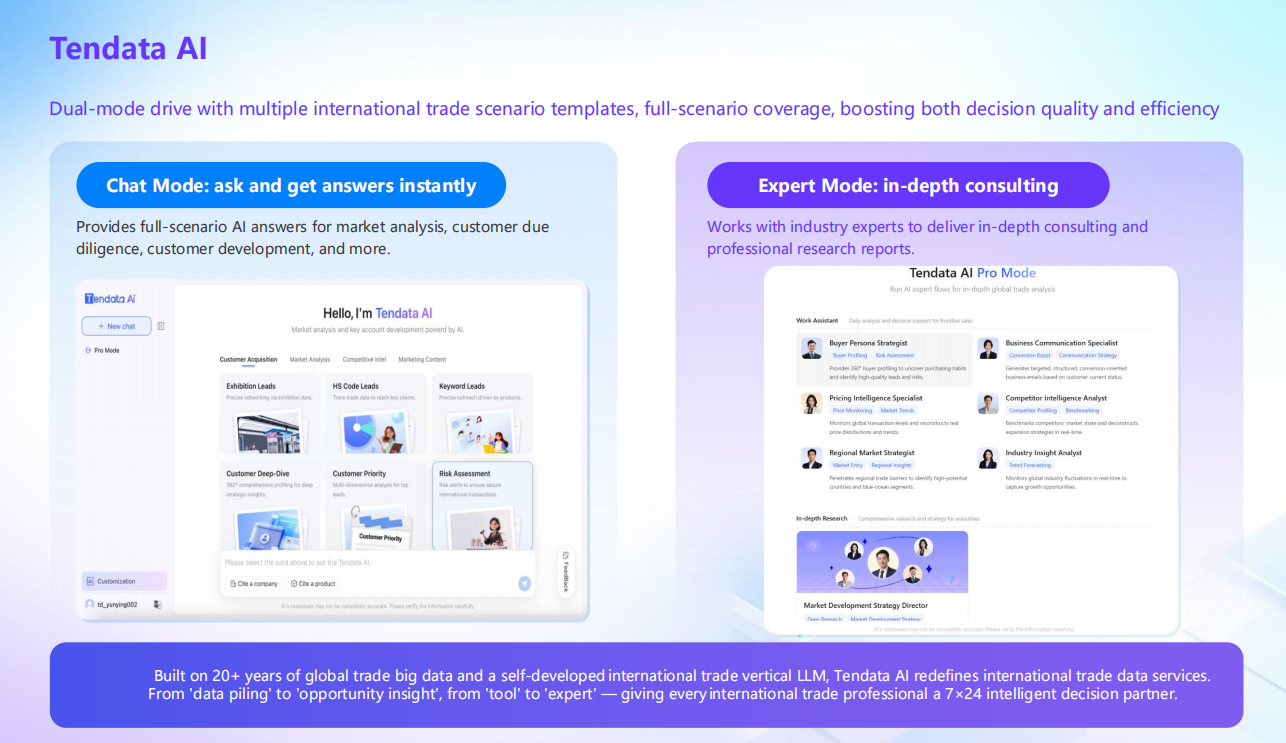
The tooling behind these stages includes Tendata AI, T-Insight, T-Discovery and T-Info. T-Info offers 17 report models and supports searches by HS code, product name and company name, generating buyer lists, supplier lists, country-of-origin lists and destination-country lists with a single click. T-Insight produces market analysis from four perspectives — customers, competitors, markets and products — with more than 100 interactive visualisations. Data standardisation and field-matching work sit underneath both, together with patents covering automated trade process management, ETL configuration generation and product name recognition.
Four Situations Where the Checklist Changes the Decision
Approving a new supplier before the first purchase order
Use checks 1 to 6 to confirm that the company ships your product at a comparable scale, then use checks 7 and 8 to confirm that the entity is stable and that you are speaking to the person who controls production or export scheduling. This sequence is designed for importers and procurement teams that need suppliers with verified export records.
Adding a second source without doubling the risk
A second supplier is usually selected under time pressure, which is exactly when self-declared information dominates. Running the same eight checks against both suppliers makes the comparison factual: continuity, destination experience and volume plausibility can be compared side by side rather than argued from impressions.
Qualifying distributors and wholesale importers
When the counterparty is a distributor rather than a producer, the delivery question changes to whether that distributor genuinely imports the category and at what frequency. Import activity, product mix and market coverage give a view of channel capability without relying on a company profile page.
Reviewing an approved supplier between orders
Approval is a point in time. Continuous monitoring lets a buyer see whether the supplier's trade pattern has changed, for example a shift in destination markets or in shipment frequency, before the change becomes a delivery problem. Tendata AI supports automatic company activity monitoring and market alerts, which turns the checklist from a one-off exercise into a recurring review.
Combining Evidence Types So the Checklist Does Not Overreach
No single evidence layer answers a delivery question on its own. The table below shows which layer belongs to which check, so that a conclusion is never built on one input.
| Evidence layer | Question it answers | Checklist stage |
|---|---|---|
| Trade records: shipment history, HS codes, counterparties, volumes | Does this supplier actually ship my product at my scale? | Checks 1, 2, 5, 6 |
| Company intelligence: business operations, financial information, products, IP, litigation and risk, news and public sentiment, trade shows | Is the entity stable and consistent with its trade profile? | Checks 3, 4, 7 |
| Contact data: titles, phone, email, professional profiles | Who controls the delivery schedule? | Check 8 |
| Monitoring and alerts | Has the supplier's trade pattern changed since approval? | Ongoing review |
Limits, Contract Terms and the Handover to Execution
Trade data improves the questions an importer asks; it does not replace quality inspection, a factory audit, sample approval or agreed contract terms. A practical sequence keeps each input in its proper role: trade records narrow the list, company intelligence confirms the entity, contact verification opens the delivery conversation, and a trial shipment tests what none of the previous steps can prove.
Two further limits are worth stating plainly. First, coverage and update frequency vary by market, so a missing record is a prompt to ask a question rather than a conclusion about the supplier. Second, access to trade data carries obligations: under Tendata's service terms, data is licensed to the subscribing company and its authorised personnel, must not be resold or redistributed as a data product, and must be used in line with the service agreement and applicable law. Supplier evaluation sits comfortably inside that scope; republishing records does not.
Tendata's own operating credentials can also be checked as part of a data-provider evaluation, since a checklist is only as good as its source: the company holds Quality Management System and Information Security Management System certification, a Data Product Registration Certificate, a Buyer & Supplier Certification Certificate, more than 150 intellectual property rights, and has served more than 100,000 companies across 20+ years in trade data services.
Conclusion
Delivery assurance is not a promise extracted from a supplier; it is a conclusion an importer reaches after comparing what a company says with what its shipments show. The eight checks in this article exist to make that comparison repeatable: continuity, product and code alignment, role in the chain, counterparty structure, destination coverage, volume plausibility, company stability and contact verification. Each one produces a question and a documented answer, and together they decide whether a supplier earns a trial order or a place on the approved list.
Used this way, import export data does not replace judgement. It gives the judgement something to stand on, and it shortens the distance between evaluation and execution.
For a fuller view of the platform, capabilities and coverage behind these checks, the Tendata company introduction brochure is available to download.
Frequently Asked Questions
What should I check when choosing an import export data service provider with global customs coverage?
Check the coverage claim against specifics: which countries and regions are included, where the records originate, how often they update, and how the provider handles duplicate or inconsistent company names and units. Tendata states coverage of 228+ countries and regions with more than 10 billion trade records, sourced from customs authorities, commercial databases and internet databases, with updates as frequent as every three days and regular standardisation of company names and quantity units. Also confirm the platform's own credentials, such as information security certification and data product registration, since you will be relying on its records for commercial decisions.
How does import export data support supplier evaluation for delivery assurance?
It replaces assumptions about a supplier's shipping behaviour with observed activity. Records show whether the company ships your product category, which HS codes it declares, how frequently shipments occur, which destination markets it serves, and who its buyers and suppliers are. Applied through a fixed checklist, that evidence tells an importer whether the supplier's normal order profile resembles the order being placed, and it identifies the questions to raise about capacity, scheduling and documentation before a purchase order is issued.
Why does it matter whether a supplier is a manufacturer, a trader or a logistics company?
Because the entity that appears in a shipment record is not always the entity that controls production. A logistics company in the data shows that cargo moved, not that the named company manufactures the product. Tendata's data processing includes distinguishing logistics companies from actual importers and exporters, which lets an evaluation team identify the right entity to audit and the right entity to contract with. Confusing the two leads to audits of the wrong facility and delivery commitments from a party that does not schedule production.
What delivery risks can trade records not confirm?
Trade records do not confirm product quality or conformity of a specific lot, available production capacity inside your delivery window, on-time performance on your trade lane, or the certification status of the goods. They also reflect declared data, and declaration practice varies by market, so an absent record is not proof that a supplier is inactive. These gaps are covered by inspection, factory audit, sample approval, certificate verification and a trial shipment, which is why the checklist is designed to narrow the field before those steps are funded.
How quickly can a team move from supplier evaluation to execution?
The documented Tendata AI Global Market Intelligence workflow runs in five stages: target profile definition, company discovery, screening and qualification, due diligence and trade intelligence, and contact discovery with personalised outreach. Because the trade data, company intelligence and contact data sit on one platform, a team does not rebuild its evidence base between stages, and Tendata AI supports one-click report generation, customer due diligence reported as completable in as little as one minute, and AI-assisted outreach drafting. Whether that pace holds for your category depends on data coverage in your target markets, which is worth confirming with the provider first; you can request a walkthrough and the catalogue materials through the contact channels published on tendata.com.
Have Questions or Need More Details?
Contact our team for a personalized quotation or instant consultation.
Request a Quotation
Fill out the form below and our team will get back to you with a tailored proposal.
WhatsApp Direct Chat
Prefer to chat in real-time? Message us on WhatsApp for instant assistance & quick answers.
- Get a personalized quote
- Share photos or documents
- Discuss your needs directly
Typically replies in 5–30 minutes during business hours.