
Import Export Data Workflows for Distributor and Trader Buyer Discovery
Short answer: a buyer discovery workflow built on import export data should start from the go-to-market motion, not from a company list. Distributors, trading companies, and B2B sales teams run four repeatable motions — entering a new country, expanding into a new region, comparing several markets, and monitoring demand for a product line — and each motion routes through a different combination of six modules: Buyer & Importer Discovery, Supplier & Exporter Discovery, Global Trade Records Analysis, Buyer & Supplier Qualification, Company Background Research, and Company Contact Discovery. Tendata (Shanghai Tendata Tech Co.,ltd) supplies the data layer for those workflows: import and export data across 228+ countries and regions, more than 10 billion trade records, 230+ industry segments, and a base of 500+ million in-depth company records, integrated with Tendata AI.
Problem definition: the qualification gap behind every buyer list
Finding a company name has never been the hard part. Confirming that the company buys what you sell, at a volume that justifies the follow-up cost, is where distributor and trading-company sales teams lose weeks. A name pulled from a directory or from a social network tells a sales team almost nothing about purchasing needs or supply capability, and the same gap appears when the prospect was found on LinkedIn: trade volume, price level, and existing supplier relationships usually stay invisible.
Contact access compounds the problem. Directory entries frequently stop at a switchboard number, and decision-maker details are missing. Trade-show inquiries arrive without indications of company size or required volume, so a team cannot judge whether the lead deserves intensified effort.
The cost of that uncertainty is measurable inside the workflow. Building a qualified customer through manual searching can take one to two weeks per customer, or it requires substantial spending on B2B platforms and search advertising to produce a single viable lead. Free customs data and ordinary search results do not return detailed trade records, supply chain relationships, or specific procurement needs.
The Yuehua case shows what happens when exposure outpaces qualification. Foshan Gaoming Yuehua Sanitary Ware generated a top-performing video with more than 3 million views and monthly organic traffic above 20 million views, yet overall conversion stayed around 0.2% because the products are not everyday consumer goods. The bottleneck was not traffic; it was the absence of a mechanism that separates companies with genuine purchasing demand from a large pool of onlookers.
Industry background: from company lists to trade-behavior records
Trade teams rarely lack data. They lack a way to reconcile it. Search engines, government statistics, international trade databases, industry research reports, B2B platforms, and research agencies each hold a fragment, and the fragments do not join cleanly: sources are fragmented, company-level intelligence is thin, real trade behavior is missing, manual research is slow, cross-country comparison is difficult, and figures are often outdated before they reach a planning meeting.
A company list and a trade record answer different questions. The list answers whether a company exists and looks relevant. The record answers whether it buys the product, how much, how often, from which suppliers, and whether that pattern is growing. For a distributor sizing a new territory, only the second question supports a budget decision.
Tendata builds its import and export data from customs authorities, commercial databases, and internet databases, and regularly standardizes company names, quantity units, and other data fields to reduce duplicate or inconsistent records. Data updates can be as frequent as every three days, which is the cadence that makes a monitoring workflow practical rather than archival.
Demand for this kind of workflow has a predictable trigger list: entering a new international market, evaluating product-market opportunities, identifying high-growth markets, analyzing import and export trends, finding major buyers and importers, running competitor market analysis, planning market entry, allocating sales and marketing resources, validating demand, monitoring market changes, and conducting annual or quarterly research. The category is growing in parallel with that demand — Mordor Intelligence projects the global trade management market at USD 2.84 billion in 2026.
The six modules of a working import export data workflow
Each module answers one decision. Configuring a workflow means choosing which modules a given motion needs, and in which order, rather than subscribing to a single undifferentiated list of companies.
| Module | Decision it answers | What the platform provides |
|---|---|---|
| Buyer & Importer Discovery | Which companies actually import this product line? | Buyer and importer lists built from trade records; T-Info generates buyer lists, supplier lists, country-of-origin lists, and destination-country lists in one click across 17 report models, searchable by HS code, product name, or company name. |
| Supplier & Exporter Discovery | Who supplies this category, and is the counterparty a real trader? | Supplier and exporter lists derived from the same records, with logistics companies distinguished from actual importers and exporters during data cleaning. |
| Global Trade Records Analysis | How much does this company buy, how often, and from whom? | Purchase volume, import trends, HS codes, suppliers, and supply chain relationships for each target company. |
| Buyer & Supplier Qualification | Is this a genuine buyer or a dead lead? | Trade-activity screening before outreach, so effort is spent on companies with verifiable shipment history. |
| Company Background Research | Is the company operationally and commercially sound? | Business operations, financial information, products, supply chain relationships, news and public sentiment, intellectual property, litigation and risk information, and trade show participation, within 500+ million in-depth company records. |
| Company Contact Discovery | Who decides, and how do I reach them? | Access to 850+ million verified business contacts, including job titles, phone numbers, email addresses, LinkedIn profiles, and Facebook profiles. |
Buyer & Importer Discovery
This module converts a product definition into a named universe. The practical test is whether the output arrives already filtered by import activity, because a list of companies that merely mention the category will send the team back to manual screening.
Supplier & Exporter Discovery
The same records run in the opposite direction. Distributors use it to map who already supplies a category and where the supply chain concentrates, which is also how they identify the counterparties a target buyer currently relies on.
Global Trade Records Analysis
Volume, frequency, HS code mix, and supplier relationships turn a name into a hypothesis. A company importing the product every month at a stable volume is a different sales conversation from a company that imported it once, two years ago.
Buyer & Supplier Qualification
Qualification is the step that removes low-quality leads before a salesperson spends time on them. In the Yuehua workflow, this step was what separated prospects with real purchasing demand from high-exposure traffic that never converted.
Company Background Research
Background research supports the commercial judgement that trade records cannot make alone: whether the counterparty is solvent, whether it holds relevant intellectual property, whether litigation or negative sentiment creates risk, and whether it is active in the trade shows where its category does business.
Company Contact Discovery
A qualified company without a reachable decision-maker is still a dead end. Contact discovery closes the loop by attaching job titles and channels to the shortlisted accounts, so the outreach step can start immediately.

Step-by-step: configuring the workflow in six steps
The sequence below is the workflow documented in Tendata's customer case material, generalized so a distributor or trading company can apply it to any of the four motions.
Four go-to-market motions and the modules each one needs
The same platform produces different outputs depending on the motion. Mapping the motion first prevents the most common failure in trade data adoption: buying access and then using it as a one-off list export.
Motion 1 — Entering a new country
The output is a ranked importer list for one product line in one country, with volume, frequency, and current suppliers attached. The decision it supports is which accounts to contact in the first quarter and which to defer. Yuehua's U.S. market entry followed this shape: identify potential U.S. buyers, analyze their trade data, qualify high-value buyers, find business contacts, and conduct targeted outreach, with one U.S. buyer eventually becoming a long-term relationship.
Motion 2 — Expanding into a new region
Regional expansion needs the same qualification logic applied across several countries at once, plus a view of wholesalers and distributors already moving the product inside the region. Supplier and exporter discovery runs alongside buyer discovery here, because a region is usually entered through existing channels rather than created from scratch.
Motion 3 — Comparing multiple markets
T-Insight generates a market analysis report from a product name or HS code and organizes it across four perspectives — customers, competitors, markets, and products — with more than 100 interactive visualizations. For a trader choosing between candidate markets, this replaces the spreadsheet consolidation stage that normally delays the comparison by weeks.
Motion 4 — Monitoring product demand
Monitoring is a cadence, not a report. Automatic company activity monitoring tracks changes in the accounts already on the list, so a distributor sees when a target buyer's trade pattern shifts rather than discovering it a year later during a renewal review.
| Motion | Modules used | Typical output | Decision supported |
|---|---|---|---|
| Entering a new country | Buyer & Importer Discovery; Global Trade Records Analysis; Qualification; Contact Discovery | Ranked importer list with volume, frequency, and current suppliers | Which accounts to contact first |
| Expanding into a region | Buyer Discovery; Supplier & Exporter Discovery; Background Research | Regional channel map of importers, wholesalers, and existing suppliers | Which channel to enter through |
| Comparing markets | Global Trade Records Analysis; T-Insight market analysis | Multi-perspective market comparison by product or HS code | Which market to prioritize |
| Monitoring demand | Trade Records Analysis; activity monitoring | Change log on target accounts and competitor activity | When to re-engage or reallocate |
Manual research versus a trade-behavior workflow
The comparison below uses only documented capability differences between directory and social-network prospecting and a records-based workflow. It is not a vendor ranking; it is a check on which stage of the process each method can actually complete.
| Dimension | Manual directory and social research | Trade-behavior workflow |
|---|---|---|
| Starting point | Company names from directories, yellow pages, LinkedIn, and trade-show badges | 10+ billion trade records across 228+ countries and regions |
| Evidence of demand | Purchase intent inferred from profile text and website copy | Purchase volume, import trends, HS codes, and supplier relationships visible per company |
| Counterparty check | Unclear whether a company actually trades the category | Logistics companies distinguished from actual importers and exporters during data cleaning |
| Decision-maker access | Switchboard-level contacts; job titles frequently missing | 850+ million verified business contacts with job titles, phone, email, LinkedIn, and Facebook profiles |
| Time to qualification | One to two weeks per qualified customer, or heavy platform and search-advertising spend per viable lead | Screening against trade activity before outreach, as in the Yuehua workflow that reduced unqualified outreach |
| Cross-market comparison | Manual consolidation of disconnected sources | T-Insight reports from a product name or HS code with 100+ interactive visualizations |
| Refresh cadence | Periodic manual re-checking | Updates as frequent as every three days, plus automatic company activity monitoring |
| Background research | Separate searches per company | Company profiles covering operations, financial information, products, supply chain, news and public sentiment, intellectual property, litigation and risk, and trade shows |
Where AI-assisted one-click discovery replaces manual name hunting
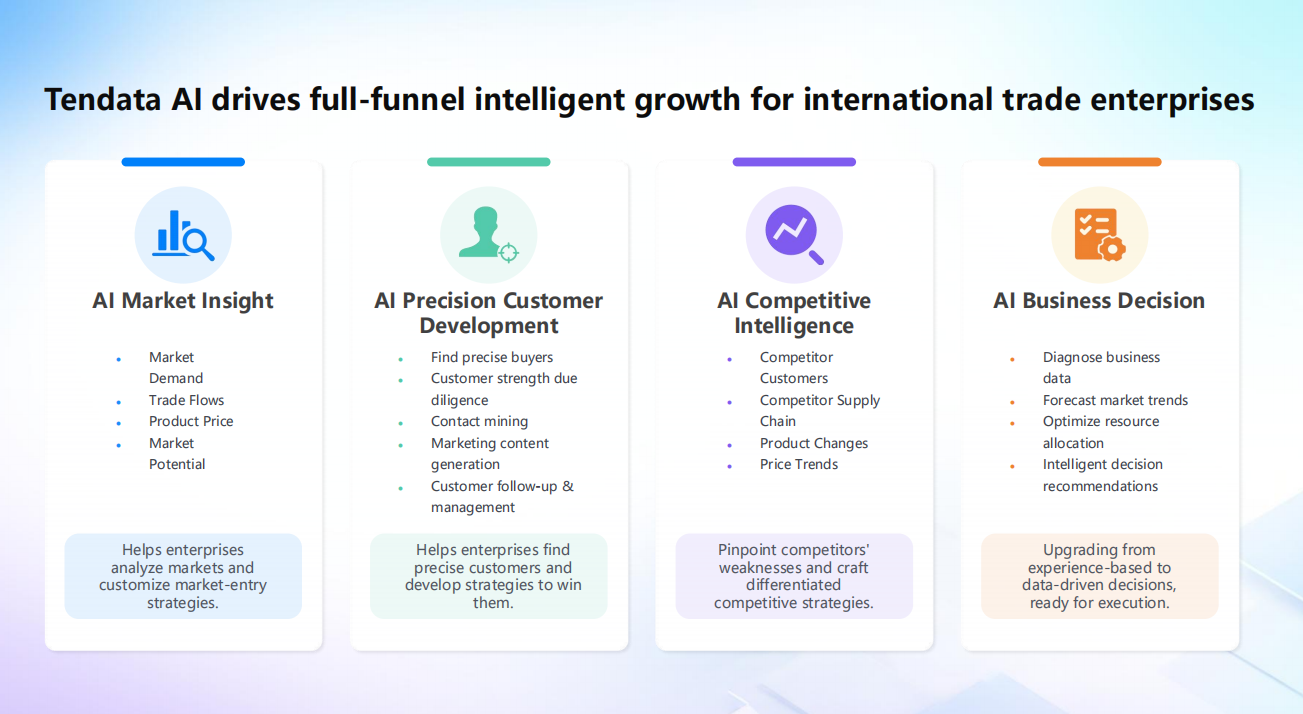
Tendata AI combines Tendata's trade databases and feature set with large language models, operating on records the company describes as real, valid, and verifiable. In practice four manual steps disappear from the workflow.
- List building. A buyer, supplier, country-of-origin, or destination-country list is generated in one click from an HS code, product name, or company name, replacing days of directory browsing.
- Market framing. A market analysis report is generated from a product name or HS code, so the market comparison starts from trade evidence instead of from an assembled reading list.
- Outreach drafting. Personalized emails and social media outreach strategies are drafted from the target prospect's actual information and requirements, which shortens the gap between qualification and first contact.
- Ongoing monitoring. Automatic company activity monitoring replaces the recurring manual check on whether a target account's trade pattern has changed.
The design assumption is worth stating plainly: the value is not that AI finds names faster. It is that the name arrives attached to trade behavior, so the first human decision in the process is a qualification judgement rather than a research task.
Case reference: Yuehua's shift from traffic to qualified buyers
Foshan Gaoming Yuehua Sanitary Ware, a sanitary ware manufacturer and exporter based in Foshan, Guangdong, ran the workflow for one year. The starting problem was not visibility: a top video exceeded 3 million views, monthly organic traffic passed 20 million views, and conversion was still around 0.2%. The diagnosis reframed the question from generating more traffic to identifying buyers with genuine purchasing demand.
Execution followed five steps: identify potential U.S. buyers, analyze their trade data, qualify high-value buyers, find business contacts, and conduct targeted outreach through email, phone, and WhatsApp. Tendata's role was the qualification layer between exposure and sales conversation. The documented results include annual sales above RMB 200 million, a major buyer purchasing approximately 500–600 units per month at roughly USD 4,000–5,000 per unit, and a long-term relationship that began when a U.S. buyer was first identified through the company's website and YouTube videos and then verified through trade data.

Frequently asked questions
Which data-governance credentials should a distributor verify before adopting an import export data workflow?
Three checks are practical. First, certification: Tendata holds a Quality Management System Certification, an Information Security Management System Certification, a Data Product Registration Certificate, and a Buyer & Supplier Certification Certificate, and was recognized as a 2025 Shanghai Digital Trade Innovation Enterprise. Second, provenance: the trade data is sourced from customs authorities, commercial databases, and internet databases, and the company states that the records are authentic and verifiable. Third, permitted use: confirm in the contract which internal and commercial uses of the records are allowed in your jurisdiction. Certifications establish the governance baseline; the contract defines what your team may do with the output.
How does an import export data service provider support global buyer prospecting?
A provider supports prospecting by delivering qualified target lists instead of names. Tendata covers 228+ countries and regions with more than 10 billion trade records, and its company base spans 230+ industry segments with 500+ million in-depth company records. T-Info generates buyer lists, supplier lists, country-of-origin lists, and destination-country lists in one click from HS code, product name, or company name searches across 17 report models. Those lists are then qualified against purchase volume, import trends, HS codes, suppliers, and supply chain relationships, and matched to 850+ million verified business contacts.
What should a distributor weigh when budgeting a trade-data buyer discovery workflow?
Budget the workflow against the manual alternative it replaces. Documented manual benchmarks put a qualified customer at one to two weeks of searching, or at a substantial B2B-platform and search-advertising spend per viable lead. Scope the platform around the motions you actually run — one country entry, one regional expansion, or one monitoring feed — and request a quote for that scope. A narrow scope with a defined output, such as a qualified importer list for one HS code in one market, is far easier to judge than a broad licence with no assigned motion.
Can a team validate the workflow on one product and one market before rolling it out?
Yes, because the entry point is a single HS code. Search the code in T-Info to generate a buyer list, then check each candidate's purchase volume, import trend, HS codes, and supplier relationships. T-Insight produces a market analysis report from a product name or HS code across customers, competitors, markets, and products, with more than 100 interactive visualizations, and Tendata AI can draft outreach for the shortlisted companies. A pilot is meaningful when three conditions hold: the records show real shipment volume, the contacts resolve to decision-makers, and the buyer already imports the product category.
How quickly do records refresh once the workflow is live?
Tendata's data updates can be as frequent as every three days, which is the cadence that matters for monitoring motions such as tracking a target buyer's trade activity or watching competitor shipments. Implementation speed depends on scope: the Yuehua project, which combined social exposure with trade-data qualification, is documented as a one-year engagement covering buyer discovery, contact discovery, and targeted outreach. Teams that need a single-market buyer list can start from one HS code search and expand after the first qualification round. To discuss a scoped start, download the Tendata Introduction brochure or send your target product and market to emarketing@tendata.cn.
Conclusion: configure the motion, then let the records qualify the list
Import export data earns its place in a distributor's workflow when it is configured around a motion rather than purchased as a list. Country entry needs discovery, trade records, qualification, and contacts. Regional expansion adds supplier and exporter mapping. Market comparison needs a report layer that can hold several countries at once. Demand monitoring needs a refresh cadence and an activity feed that keeps the shortlist honest.
Tendata's coverage supports all four motions from one data layer: 228+ countries and regions, 10+ billion trade records, 230+ industry segments, 500+ million in-depth company records, and 850+ million verified business contacts, delivered through T-Info, T-Insight, and Tendata AI. The workflow decision that matters is narrower than the platform decision: choose one motion this quarter, define the output that proves it worked, and measure the result against the one-to-two-week manual baseline the team is replacing.
Next step: map one motion to one workflow
Pick the single motion your team is running this quarter, and test it against a real product code. Download the Tendata Introduction (PDF) for the platform overview, or send your target product, HS code, and market for a scoped walkthrough.
Email: emarketing@tendata.cn | Tel / WhatsApp: +86 187 2199 2033 | www.tendata.com
Published case reference for the distributor workflow described above: Yuehua customer case.
Have Questions or Need More Details?
Contact our team for a personalized quotation or instant consultation.
Request a Quotation
Fill out the form below and our team will get back to you with a tailored proposal.
WhatsApp Direct Chat
Prefer to chat in real-time? Message us on WhatsApp for instant assistance & quick answers.
- Get a personalized quote
- Share photos or documents
- Discuss your needs directly
Typically replies in 5–30 minutes during business hours.