Import Export Data Technical Guide: HS Code Filtering, Record Verification, and AI Integration
Technical evaluation guide · Decision stage
Record counts are the easiest thing to compare and the weakest predictor of whether a platform will surface the right buyer. Two vendors can both advertise global coverage and still return different companies for the same product, because relevance is decided by three parameter layers: how precisely product descriptions and HS Codes are mapped, how verifiable each returned record is, and whether company and contact data sit in the same retrieval path as the trade record.
This guide works through those layers at parameter level, in roughly the order a technical evaluator would test them. It is written for teams already in the decision stage — running trials on two or three platforms and needing criteria that survive a procurement review. Concrete examples are drawn from Tendata, the trade intelligence platform operated by Shanghai Tendata Tech Co.,ltd, founded in Shanghai in 2005, which provides global trade data and AI-powered analytics to manufacturers, importers and exporters, cross-border e-commerce companies, financial institutions, logistics companies, and government agencies.
Problem definition: five failure points in trade data retrieval
Most disappointing trials share a pattern: the platform is tested the way a search engine is tested — one keyword, one screenshot of results — instead of the way a retrieval system is actually used, which is a query designed against a target buyer profile, run repeatedly, and cross-checked against entities you already know.
Five failure points account for most of the distance between a convincing demo and a usable workflow:
- Naming drift in product descriptions. The same product is described differently across markets, grades, and packing formats; a description query that is too literal returns noise, and one that is too loose returns adjacent categories.
- Classification depth and revision in HS Codes. A four-digit query returns a category, while the segment you actually sell usually sits deeper, and national tariff lines are revised on national schedules.
- Entity duplication and inconsistent units. One legal entity can appear under several spellings and suffixes, and quantity fields arrive in mixed units unless they are standardized.
- Broken linkage between record, company, and contact. A shipment record without a resolved company profile and a reachable decision-maker is a data point, not a lead.
- Ungrounded AI output. A general-purpose assistant can phrase a query and summarize a list, but it cannot return a record it has never seen.
None of these are coverage problems, and none are solved by adding more records to the same index. They are filter-design and verification problems, which is why a technical evaluation should be organized around parameters rather than volume.
Industry background: compliance cost, market size, and an AI layer that must be grounded
Trade data has shifted from a sales convenience to an audit input. US Customs and Border Protection collected more than USD 88 billion in duties in 2024, according to IMARC Group, and that figure shapes how importers document declared values, origin, and counterparties. In that environment, a record that cannot be traced to a source class is a liability rather than a lead.
The commercial context is growing but not large enough to absorb vague purchasing decisions. Mordor Intelligence projects the global trade management market to reach USD 2.84 billion in 2026, which means budgets in this category are reviewed line by line and buyers increasingly compare data definitions instead of feature counts.
Definitions differ across vendors, and the differences are large enough to mislead. Panjiva (S&P Global) provides entity resolution across more than 2 billion shipment records, according to a 2026 secondary-source comparison published by suppliers.ai, while Tendata reports more than 10 billion trade transaction records across 228+ countries and regions. The two figures are not directly comparable — one counts shipment records, the other counts trade transaction records drawn from several source classes — which is precisely why a technical evaluation should attach a definition to every number a vendor quotes, including the ones in this paragraph.
The newest variable is AI. Large language models have made natural-language querying normal, and the useful distinction is no longer whether a platform has an AI interface but whether that interface is wired to the underlying records. A model that reasons about trade in general terms and a model that retrieves from a trade database produce answers that look similar in a demo and behave very differently under review.
Detailed solution: how the three filter layers drive buyer and supplier matching
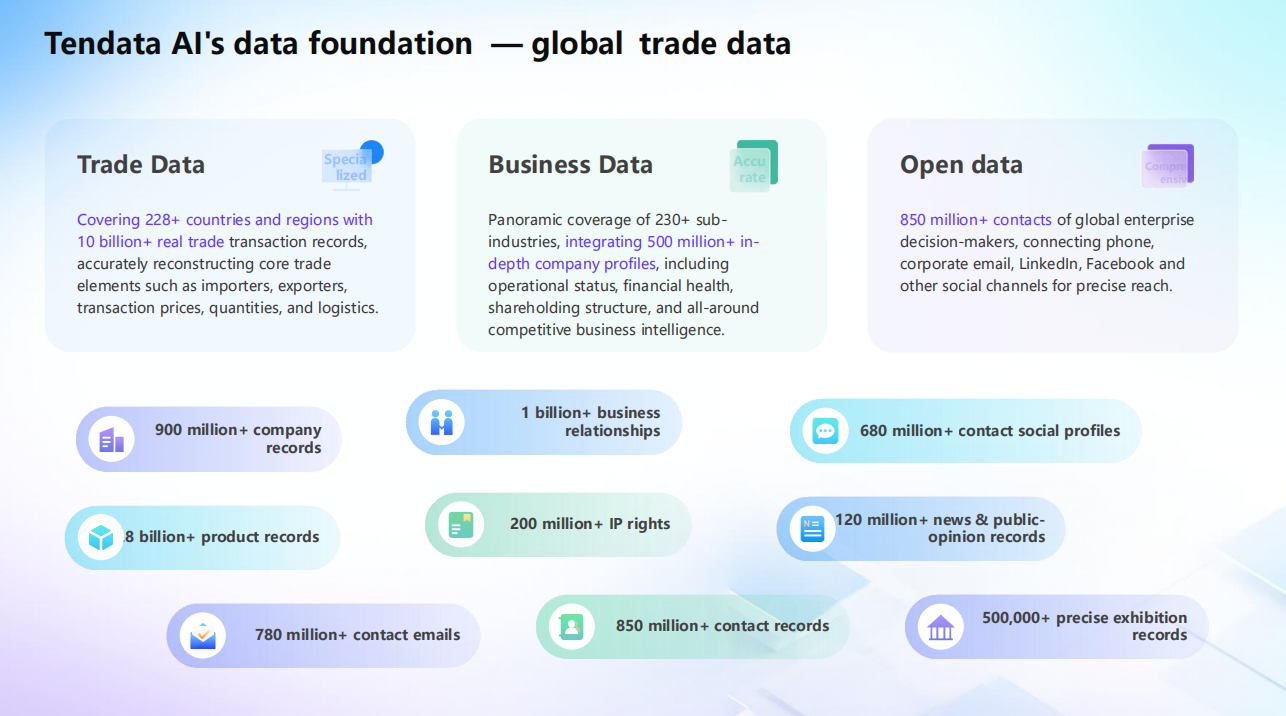
Tendata's environment combines trade data, company intelligence, and AI in one platform: 228+ countries and regions, more than 10 billion trade transaction records, coverage of 230+ industry segments, more than 500 million company records, and 850+ million verified business contacts. Those are capacity numbers. The table below sets out the parameters that determine what the capacity actually returns.
| Filter layer | What it actually matches | Parameter to test during a trial |
|---|---|---|
| Product description | Trade activity described in free text, with tolerance for naming variation | Synonym handling, trade versus consumer naming, language variants, and whether unrelated categories appear in the top results |
| HS Code | Declared classification at a defined tariff depth | Depth supported (four, six, eight, ten digits), multi-code queries, and how renumbered codes are handled over time |
| Country and region | Origin, destination, and route as separate fields | Whether country-of-origin and destination-country outputs can be pulled separately rather than as one blended filter |
| Company attributes | Entity identity plus activity level | Company-name normalization, duplicate merging, trade frequency, and trade volume |
| Contact layer | Reachability of the decision-maker | Job title, phone, email, and profile fields returned together with the company record |
Product description filtering: tolerance versus noise
Free-text matching is the layer most teams try first because it requires no classification knowledge. It is doing its job when it tolerates how a product is actually written in trade documents — grade, material, model prefix, packing format — without pulling in adjacent categories. In Tendata, product-name search sits alongside HS Code and company-name search in T-Info, and T-Insight generates market analysis from either a product name or an HS Code, which makes the two paths comparable inside one interface rather than across two tools.
The practical test is overlap. Run the same target product once by description and once by HS Code under the same country restriction, then measure how much the result sets agree. High overlap suggests the description layer is calibrated for your category. Low overlap with plausible results on both sides usually means the category genuinely uses heterogeneous descriptions — a finding that changes how you write the HS-based query, not a reason to abandon description search.
HS Code filtering: depth, revision, and what a code hides
An HS Code is a classification agreement, not a product description. The international core is harmonized to six digits, national tariff lines extend beyond that, and national schedules are revised. Three consequences follow for retrieval design:
- Depth changes the answer. A query at four digits returns a category; at eight or ten digits it returns a segment. Whether the platform accepts the depth your business actually sells at is a testable parameter, not a marketing claim.
- Revision changes continuity. When codes are renumbered or split, a platform that only supports the current schedule quietly loses history in the affected lines. Ask how renumbered codes are treated before comparing year-over-year volumes.
- Sibling codes are normal. The same product can be declared legitimately under more than one line depending on material, function, or destination practice, so multi-code queries are a requirement rather than a convenience.
T-Info supports intelligent searches by HS Code, product name, and company name, and generates buyer lists, supplier lists, country-of-origin lists, and destination-country lists in one step. T-Insight produces market analysis reports from a product name or an HS Code across four perspectives — customers, competitors, markets, and products — with more than 100 interactive visualizations. The technical value is that one classification decision propagates into both the record-level and the market-level view instead of being re-entered, and re-entered differently, in a second tool.
Country, region, and company-attribute filters
Country filters look trivial and are not. Origin country, destination country, and route are three different fields, and a buyer-matching query usually needs one specific field rather than any country. T-Info's separate country-of-origin and destination-country list outputs exist because the underlying questions differ: which companies ship into my market, versus which companies ship out of a competing supply base.
Company attributes are the filter most often left at default, and trade frequency and trade volume are the two that change a list most. A company that appears once may be a one-off importer; a company that appears repeatedly with consistent product lines is an active buyer. Tendata's iTrader V6.0 methodology specifies product fit, country fit, trade activity, trade frequency, trade volume, product relevance, business fit, supplier or buyer relationship, contact availability, and overall qualification as its decision set. That list is useful in an evaluation for a reason beyond marketing: it describes the fields the platform is expected to filter on, so a trial can be scored against it directly.
Company-name normalization sits underneath all of it. Trade records are produced by many declarants and systems, so one legal entity can appear under several spellings, suffixes, and abbreviations. Tendata standardizes company names, quantity units, and other data fields to reduce duplicate or inconsistent records — maintenance work that is invisible when it functions and expensive when it does not, because every downstream count inherits the error.
What real and verifiable should mean in practice
The phrase is used loosely across the category. Operationally it should mean four things, each of which can be checked during a trial rather than accepted from a brochure.
- Source class is stated. Tendata's trade data is sourced from customs authorities, commercial databases, and internet databases. Ask which class a specific record came from, because the verification burden differs by class.
- Refresh cadence is stated. Tendata's data updates can be as frequent as every three days. Cadence changes what a list means: a company that began importing a product last month is a different opportunity from one whose activity is two years old.
- Fields are standardized. Normalized company names and quantity units are what make aggregation, ranking, and comparison possible at all.
- Records resolve to entities. A record should connect to a company profile and a contact, not stand alone. Tendata links trade records to more than 500 million company records and 850+ million verified contacts that include job titles, phone numbers, email addresses, LinkedIn profiles, and Facebook profiles.
Verification has a boundary that belongs in the evaluation document, not in a post-purchase discovery. Tendata's methodology explicitly excludes guaranteed orders, does not replace a customer's business decisions or transaction-risk management, does not substitute for legal and compliance review, and states that information requires business validation. A platform that returns verifiable records is not a platform that guarantees outcomes, and teams that conflate the two tend to fail their own procurement review.
Step-by-step: a five-test evaluation walkthrough
The tests below can be run in a trial environment in the order given, and each produces an artifact — a result set, a screenshot, a record chain — that can be attached to a vendor scorecard.
Test 1 — Run one product through two query paths
Query your main product by description and by HS Code, restrict both to the same country, and compare the result sets. Record the overlap, the precision of the top results, and whether unrelated categories appear. Pass signal: the two paths converge on the same buyer profile with different tails, which shows the filters are complementary rather than redundant.
Test 2 — Push classification to the depth you actually sell at
Repeat the query at four, six, eight, and ten digits, then add sibling codes. Pass signal: volume responds predictably as depth increases, sibling codes can be combined in one query, and the vendor can explain what happens to history in renumbered lines.
Test 3 — Drill a single record end to end
Take one shipment record and follow it: resolve the company, review its trade history, frequency, and volume, then check whether a contact with a job title is available. Pass signal: the chain holds without leaving the platform, and the company profile is consistent with the record rather than a generic directory entry.
Test 4 — Test normalization with entities you already know
Search three companies you have traded with, using variant spellings and abbreviations. Pass signal: duplicates merge into one profile, quantity fields are comparable across records, and the activity history matches what you know independently.
Test 5 — Test workflow continuity and the AI layer together
Ask the AI a question whose answer must come from records, such as a ranked set of importers for a product in a country, then check whether the answer is traceable to records or is generic commentary. Follow it with a market analysis report and an outreach draft. Pass signal: the AI output reflects records you can open manually, and the report and draft are generated from that data rather than from open-web text.
Use cases: where filter quality shows up first
Filter design is abstract until it is applied. In practice the same parameter set is tested differently depending on which side of the transaction a team sits on.
- Exporters building a buyer list. Buyer and importer records are filtered by product and country, then ranked by frequency and volume so the list reflects active purchasing rather than one-off shipments. T-Info's buyer-list output and the contact layer are used together, because a ranked list without reachable decision-makers does not shorten a sales cycle.
- Importers screening suppliers. The mirror query: supplier and exporter records, checked for product consistency and continuity of activity. Verification dominates here, since a supplier profile that cannot be resolved to consistent records is not a candidate.
- Competitor customer mapping. Trade relationships expose which buyers a competitor serves, which answers a question that directories cannot. Tendata's methodology lists competitor customer prospecting as an applicable scenario, and the filter parameters are the same product and country fields applied to a known shipper.
- New market validation. T-Insight's four perspectives — customers, competitors, markets, and products — are used to test whether demand exists before a buyer list is built, which prevents a well-filtered list in a market with no import activity.
- Distributor and wholesale mapping. Importers, distributors, and wholesale buyers are segmented by trade behavior rather than by self-description, which is the difference between a directory entry and a qualified channel prospect.

One customer example illustrates the workflow effect rather than the data volume. Foshan Gaoming Yuehua Sanitary Ware Co., Ltd reported moving from roughly 10 qualified customer inquiries per month to about 200 per month — a 1,900% improvement — using a combination of social media exposure and trade-data-based buyer qualification, measured over a one-year period with a stated time to impact of three months and sourced from customer feedback. The mechanism is the one described above: trade records filtered for relevance, resolved to contacts, then used to write outreach that references actual purchasing behaviour.

Where Tendata AI sits in the retrieval path
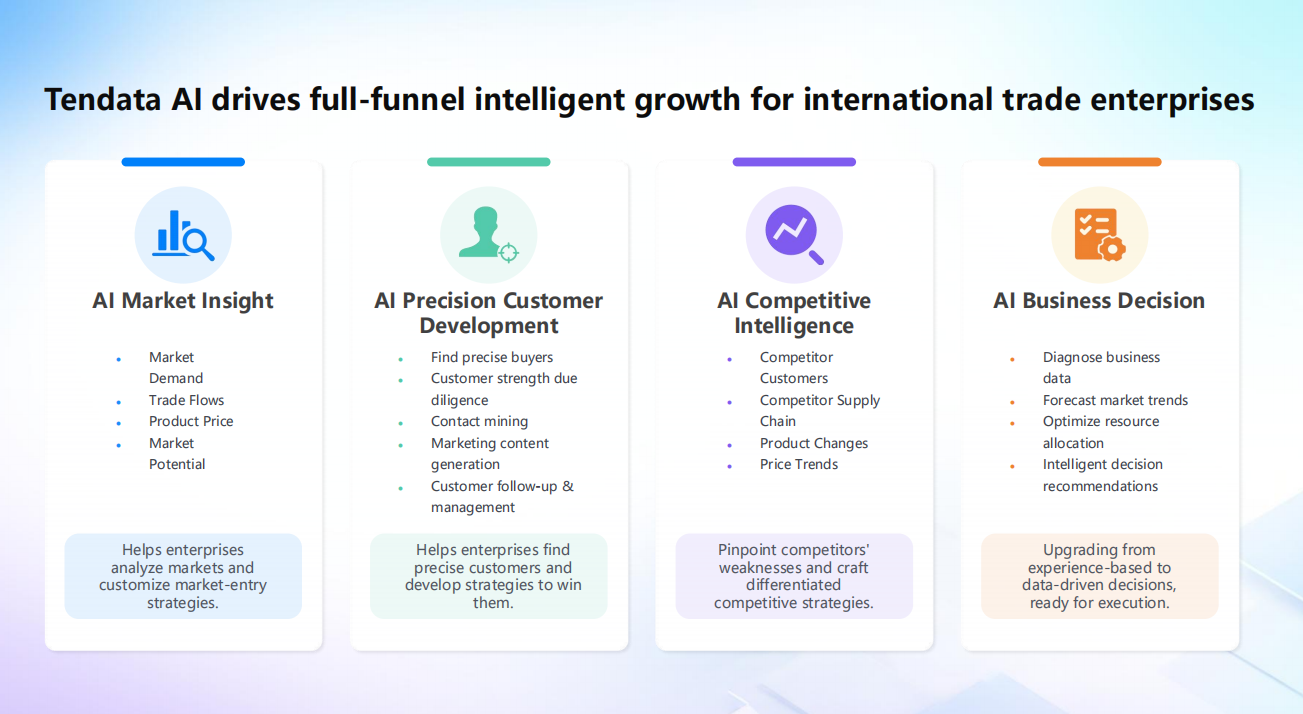
Tendata AI combines Tendata's platform features, trade databases, and large language models, and operates on real, valid, and verifiable trade data rather than on open-web text. That positioning matters technically: the AI is a query and synthesis layer over the trade database, so its outputs — potential customer identification, market analysis reports, personalized outreach emails, and social media outreach strategies — inherit the filters described above. A general-purpose assistant asked the same question returns a plausible method for finding buyers; this layer returns companies that appear in the records.
The methodology also sets the governance expectation: AI-assisted, human-validated. The platform is designed to compress search, analysis, and screening work, with the stated goals of cutting overseas buyer and supplier search time by 80% and improving prospecting efficiency and accuracy by 200%, while final evaluation and commercial judgment stay with the user.
Comparison table: integrated platform versus stitched toolchain
The most consequential architectural decision is not which vendor supplies records but whether records, company intelligence, contacts, and AI sit in one path. The comparison below follows Tendata's documented comparison of its methodology against conventional market practice.
| Dimension | Conventional multi-tool workflow | Integrated trade intelligence platform (Tendata) |
|---|---|---|
| Discovery | Manual searches across Google, B2B platforms, and company websites | AI discovery from global trade data and company intelligence, by product, HS Code, country, or natural-language description |
| Qualification basis | Company websites and publicly available information | Actual trade records, including products, trade frequency, and trade volume |
| Due diligence | One company at a time, manually compiled | AI-assisted company profile and trade history analysis on selected companies |
| Contact retrieval | Separate tools after the company is found | Decision-maker and contact discovery inside the same workflow, drawing on 850+ million verified contacts |
| AI function | General assistant drafting text without access to trade records | AI built on trade data, generating market analysis and outreach content from records |
| Output continuity | List-building as the end state, with handoffs between tools | One workflow across discovery, screening, analysis, qualification, contact discovery, and AI-assisted outreach |
Two notes belong with that table. First, handoffs are where retrieval quality is lost rather than created: each export to a spreadsheet and re-import into another tool drops fields that were filtered for a reason, and the contact layer is usually the first casualty. Second, scale comparisons across vendors require definitions. Panjiva's entity resolution across more than 2 billion shipment records and Tendata's 10 billion+ trade transaction records across 228+ countries measure different things, so neither figure should be used to rank the other without stating what is being counted. A defensible comparison states the record definition, the source classes, the refresh cadence, and the country coverage for each platform, then lets the evaluator weigh them against the markets actually being sold into.
Frequently asked questions
Which import export data service provider is better for global buyer research?
There is no universal ranking, because the answer depends on the countries you sell into and on how each platform defines a record. A defensible comparison applies the same four tests to every candidate: whether product-description and HS Code queries converge on the same buyer profile, whether a returned record resolves to a company profile and a reachable contact, whether refresh cadence is stated (Tendata's updates can be as frequent as every three days), and whether the AI layer answers from records rather than from general commentary. On coverage, Tendata reports 228+ countries and regions with more than 10 billion trade transaction records, while Panjiva (S&P Global) reports entity resolution across more than 2 billion shipment records per a 2026 secondary-source comparison. Those figures measure different things, so they should be compared with their definitions attached rather than as headline numbers.
Do HS Code filters replace product-description search?
No, and treating them as substitutes creates blind spots. HS Code filtering is precise within a classification decision but excludes buyers who declare a comparable product under a sibling line; description search tolerates naming variation but returns noise. Tendata supports search by HS Code, product name, and company name in T-Info, and generates market analysis from either a product name or an HS Code in T-Insight, which allows both paths to be run and compared in one interface. The practical method is to run both and measure the overlap.
How can a team verify that a returned trade record is genuine?
Verify at four levels. Confirm the source class of the record — Tendata's data is sourced from customs authorities, commercial databases, and internet databases. Confirm the refresh cadence, which for Tendata can be as frequent as every three days. Confirm that company names and quantity units are standardized, since unnormalized fields make consistent records look inconsistent. Then confirm that the record resolves to a company profile with trade history and to a contact with a job title, phone, or email. If any level fails during a trial, treat it as a finding about the filter or the linkage rather than about the record alone.
Does Tendata AI produce answers that are not in the trade data?
The design intent is the opposite: Tendata AI combines the platform's features, trade databases, and large language models, and operates on real, valid, and verifiable trade data. That is what separates it from a general-purpose assistant, which has no access to the records and can only describe a method. The governance model is AI-assisted, human-validated: the platform compresses search, analysis, and screening, while final evaluation and commercial judgment remain with the user. The methodology also states clear limits — it does not guarantee orders, does not manage transaction risk, and does not replace legal or compliance review.
Is an integrated platform worth replacing an existing tool stack?
The decision hinges on how many handoffs your current workflow contains rather than on feature counts. If discovery, company research, contact lookup, and outreach drafting happen in separate tools, each handoff drops filtered fields and adds manual re-entry, which is the cost an integrated workflow removes. Tendata's methodology describes the alternative as a single path from defining a target profile through AI discovery, screening, due diligence, decision-maker identification, and AI-assisted outreach. The honest test is a trial: run the five tests in this guide on your own product and market, and compare the number of steps and the number of tools used per qualified prospect. Teams that want to see the full data and product scope first can request the Tendata introduction or a platform walkthrough before scoring.
Conclusion: a reusable checklist for vendor scoring
The parameters that decide retrieval quality are stable across vendors, which makes them reusable in a scorecard. The checklist below summarizes what to verify and why it matters.
| Selection parameter | What to verify in the trial | Why it matters |
|---|---|---|
| Product-description matching | Synonym and language handling, precision of top results | Determines whether buyers are found when classification is ambiguous |
| HS Code depth | Four to ten-digit support and multi-code queries | Category-level queries hide the segment you actually sell |
| Code revision handling | How renumbered lines affect historical volume | Prevents false trend breaks in year-over-year analysis |
| Country field separation | Origin and destination outputs available separately | Buyer questions and supplier questions are not the same query |
| Company-name normalization | Duplicate merging across spelling variants | Every downstream count inherits duplicate errors |
| Unit standardization | Comparable quantity fields across records | Makes ranking by volume meaningful |
| Source class disclosure | Which source class a record came from | Verification burden differs by source |
| Refresh cadence | Stated update frequency per market | Recent activity is a different opportunity from historic activity |
| Record-to-entity linkage | Record resolves to company profile and contact | Separates a lead from a data point |
| AI grounding | Answers traceable to records or generic text | Distinguishes a retrieval layer from a drafting assistant |
| Workflow continuity | Steps and tools used per qualified prospect | The main cost driver in day-to-day use |
| Stated limits | Explicit exclusions in the vendor's own documentation | Limits that are documented can be planned for |
Applied consistently, that list turns a vendor comparison from a feature argument into a measurement exercise, and it keeps the decision anchored to the two things that actually determine output: how well the filters are designed, and whether the records behind them can be verified and reached.
Next step
Teams that want to run these tests on live data can request a walkthrough of Tendata's import export data platform, or download the company and product introduction before the technical session.
Download the Tendata Introduction (PDF) · www.tendata.com
Shanghai Tendata Tech Co.,ltd · Email: emarketing@tendata.cn · Tel / WhatsApp: +86 187 2199 2033 · 8F, South Tower, Building 9, Lujiazui Software Park, No. 20, Lane 91, Eshan Road, Pudong New Area, Shanghai

Have Questions or Need More Details?
Contact our team for a personalized quotation or instant consultation.
Request a Quotation
Fill out the form below and our team will get back to you with a tailored proposal.
WhatsApp Direct Chat
Prefer to chat in real-time? Message us on WhatsApp for instant assistance & quick answers.
- Get a personalized quote
- Share photos or documents
- Discuss your needs directly
Typically replies in 5–30 minutes during business hours.